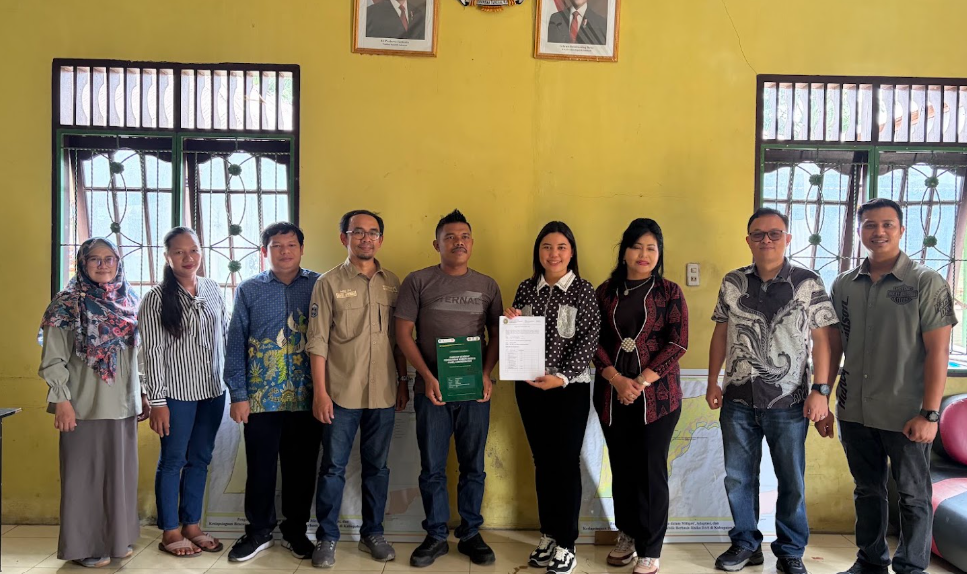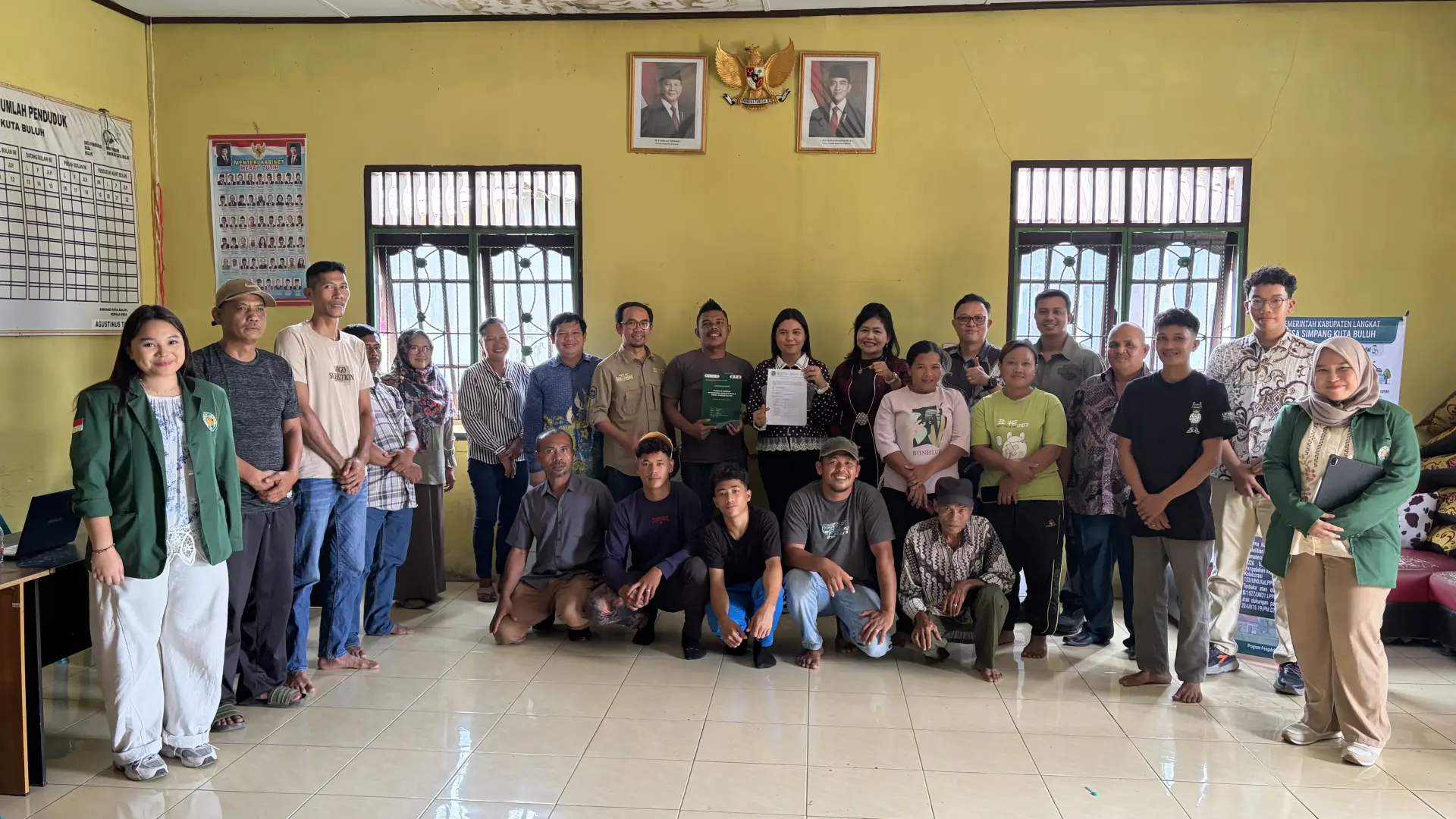
The collaborative community service program involving Universitas Sumatera Utara (USU), Universitas Terbuka (UT), and Universitas Andalas (UNAND) in Simpang Kuta Buluh Village focused on mitigating hydrometeorological disasters and improving the efficiency of village asset management. The program included the distribution and planting of slope-strengthening seedlings to prevent erosion and landslides. In addition to ecological interventions, the program equipped village officials with education on technology-based asset maintenance and Geographic Information System (GIS) mapping to document the condition of public infrastructure and determine disaster evacuation routes.
The hilly area of Simpang Kuta Buluh Village, Sei Bingei District, Langkat Regency, has a very high level of vulnerability to hydrometeorological disasters, such as landslides and tornadoes. The village’s geographical conditions, characterized by steep slopes and surface water channels, frequently expose public infrastructure to damage caused by erosion and ground movement during periods of increased rainfall. Repeated damage ultimately leads to inefficient use of the village budget, as available funds are continuously spent on physical infrastructure repairs. This directly affects residents’ economic well-being, as damaged access routes and economic-supporting facilities may increase the risk of communities falling into poverty. This mitigation effort is in line with SDG 1 (No Poverty), in which the protection of essential public village assets aims to maintain economic stability and safeguard the livelihoods of vulnerable communities from material losses caused by natural disasters.
As a response to this vulnerability, the Higher Education Collaborative Community Service Team, involving Universitas Sumatera Utara (USU), Universitas Terbuka (UT), and Universitas Andalas (UNAND), distributed specialized plant seedlings as a form of community-based ecological mitigation intervention. The distribution and planting of slope-strengthening seedlings focused on areas vulnerable to ground movement to naturally reinforce soil structures. Strong root systems are effective in reducing soil erosion and stabilizing hilly slopes during periods of heavy rainfall. This green initiative directly supports SDG 2 (Zero Hunger) through an environmentally sustainable approach. Maintaining vegetation not only helps prevent landslides that could damage residents’ agricultural land but also preserves soil fertility and local ecosystems, thereby supporting the long-term food security of village communities.
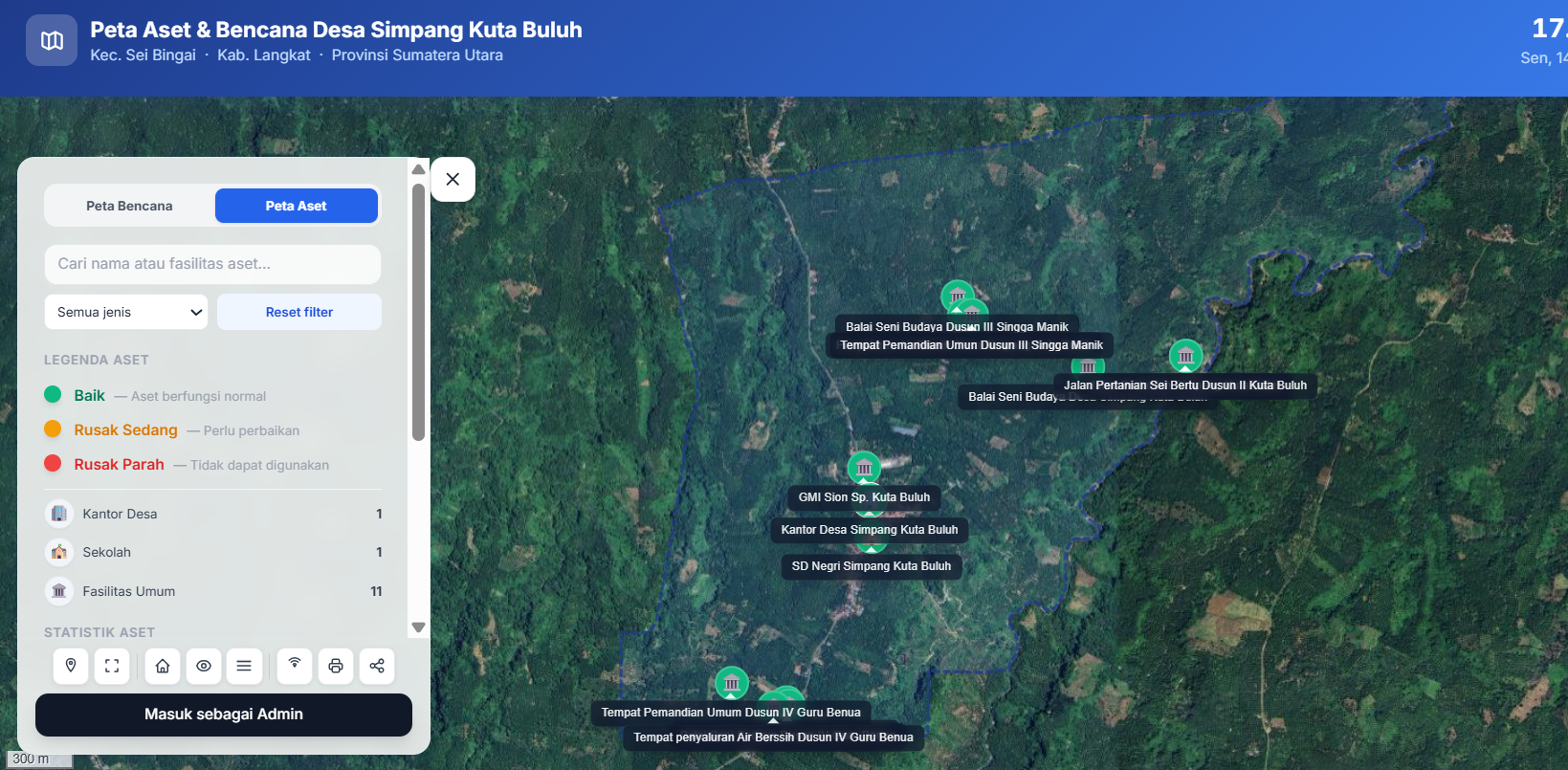
Through technical assistance in Geographic Information System (GIS) and GPS-based mapping, village officials were taught how to identify, document, and classify the level of risk and potential damage to vital public assets, such as village offices, roads, health facilities, schools, and places of worship, using a digital village mapping platform. This hands-on training directly transferred knowledge to village officials, enabling them to independently operate the system and update physical asset condition data in real time. The initiative reflects the principles of SDG 4 (Quality Education), in which practical knowledge and geospatial technology literacy are provided to strengthen human resource capacity at the local level and enable communities to manage disaster-prone areas more effectively.
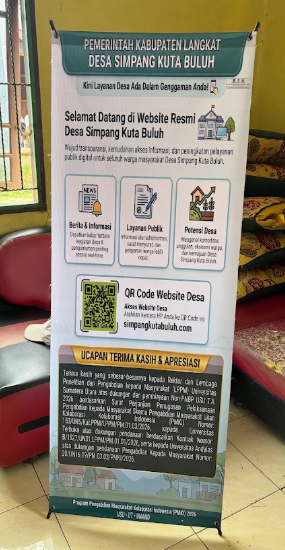
The integrated efforts combining vegetation-based mitigation through the distribution of plant seedlings with digital asset maintenance education have had a significant impact on improving community safety and environmental health. The availability of digital maps containing information on assembly points and evacuation routes directly strengthens the emergency response system and minimizes the risk of casualties during extreme weather events. Protecting health facilities and other public village infrastructure from landslide threats also helps ensure that public services continue to operate without disruption. This initiative is aligned with SDG 3 (Good Health and Well-Being), which emphasizes the importance of creating safe residential environments, reducing the risk of disaster-related injuries and fatalities, and ensuring community access to sustainable environmental health facilities and infrastructure.
The implementation of the community service program in Simpang Kuta Buluh Village demonstrates a concrete effort to strengthen local institutional capacity through multidisciplinary collaboration. With new knowledge on integrated asset maintenance, the village government can redirect Village Fund allocations toward more productive empowerment programs rather than repeatedly spending resources on repairing infrastructure damaged by disasters. This public asset management approach applies the principle of build back better, safer, and sustainable, enabling Simpang Kuta Buluh Village to transform into a self-reliant village with strong disaster resilience, both ecologically and in terms of spatial data governance. The success of this mitigation-based asset management initiative is expected to serve as a role model for other villages in Langkat Regency and North Sumatra.
The overall success of the mitigation and asset management education initiative would not have been possible without the implementation of SDG 17 (Partnerships for the Goals). The strategic collaboration initiated by Dr. Lasma Melinda Siahaan, S.E., M.Si., together with Prof. Dr. Elisabet Siahaan (USU), Yasir Riady, S.S., M.Hum. (UT), and Prof. Ir. Taufika Ophiyandri, Ph.D. (UNAND), in close coordination with Village Head Agustinus Tarigan and local residents, demonstrates the importance of cross-sectoral synergy. The integration of expertise in asset management, geospatial analysis, and disaster mitigation from the three universities bridges academic knowledge with the community’s practical needs on the ground. This collaborative partnership among academics, the village government, and local community leaders serves as a key foundation for achieving adaptive, safe, and sustainable village development in addressing the challenges of climate change.