


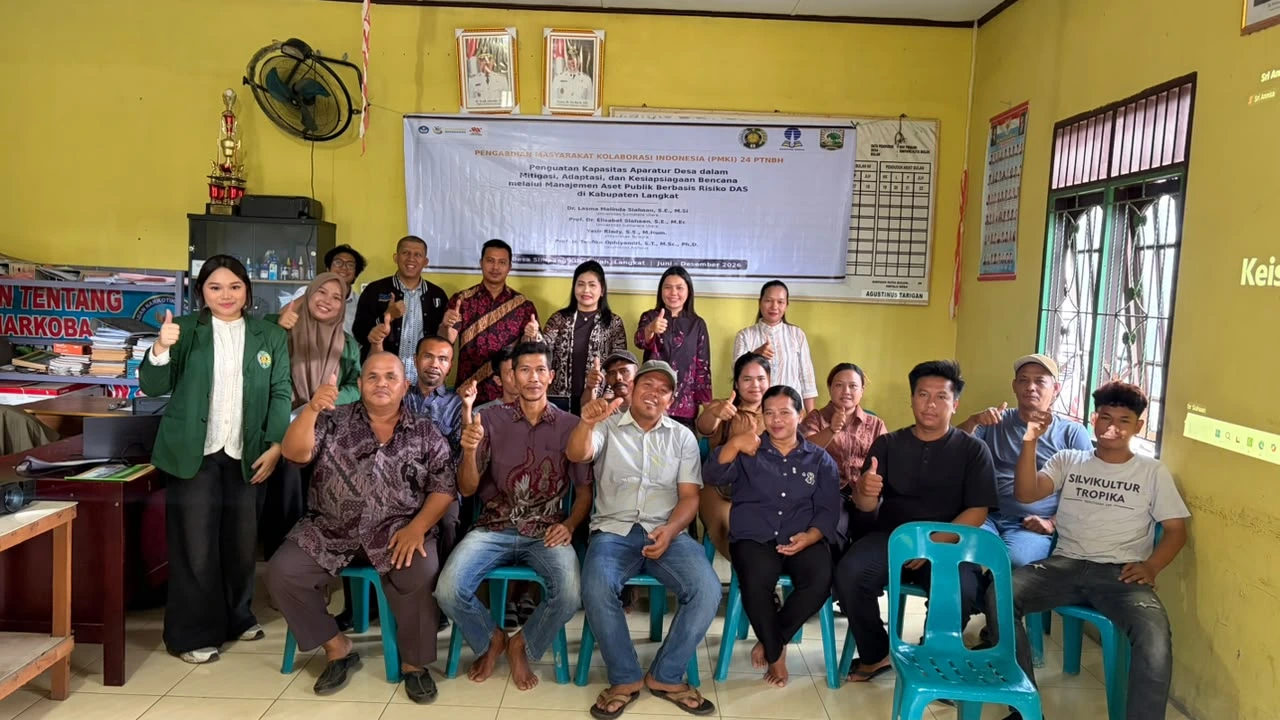
Langkat, July 20, 2026 – The commitment of higher education institutions to supporting disaster-resilient rural development was once again demonstrated through the implementation of the Indonesian Collaborative Community Service Program (Program Pengabdian Masyarakat Kolaborasi Indonesia/PMKI), involving 24 State Universities with Legal Entity Status (PTNBH). The program was held in Kutabuluh Village, Langkat Regency, North Sumatra, under the theme "Socialization and Capacity Building for Village Officials in Disaster Mitigation, Adaptation, and Preparedness through Risk-Based Public Asset Management."
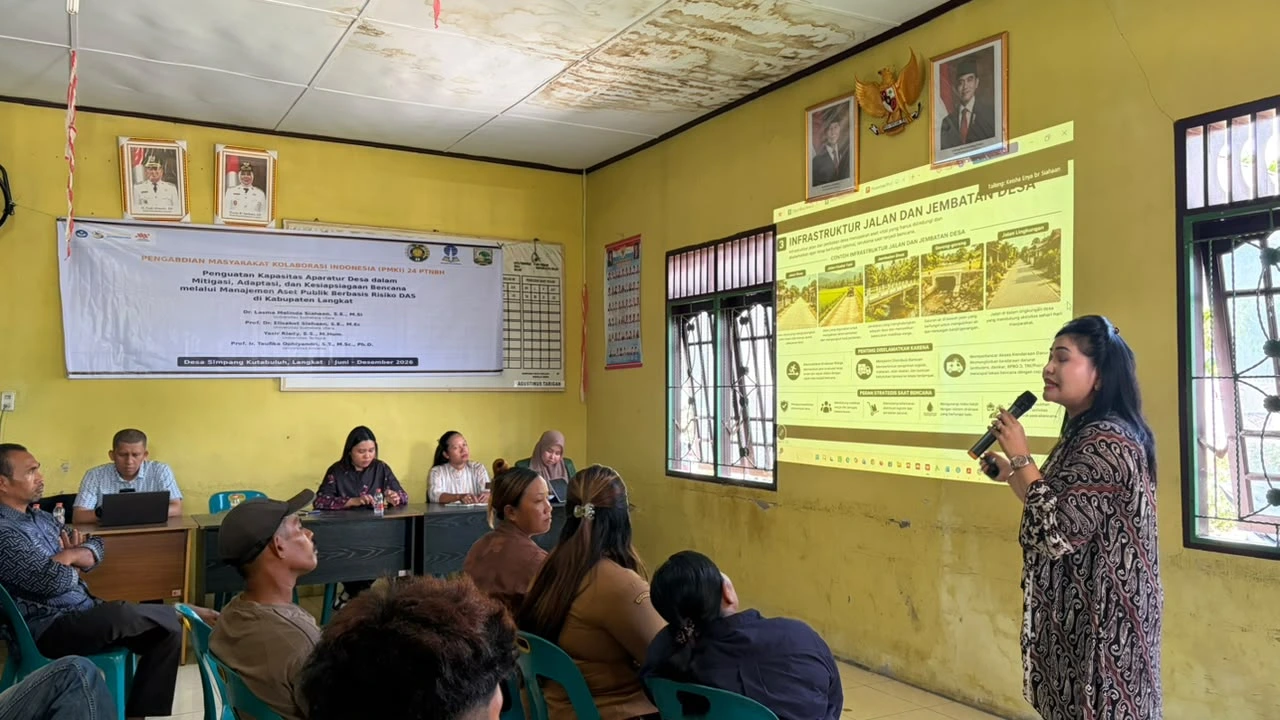
The program was designed to enhance the capacity of village government officials in understanding the importance of managing public assets with disaster risks in mind, particularly in disaster-prone areas. This approach has become increasingly important as the frequency and intensity of hydrometeorological disasters driven by climate change continue to rise, posing significant threats to public services, rural development, and the sustainability of strategic public assets owned by village governments.
Strengthening village governments' capacity to implement risk-based public asset management aims not only to reduce the impacts of disasters but also to contribute to the achievement of the Sustainable Development Goals (SDGs), particularly SDG 1 (No Poverty) by protecting community economic assets, SDG 2 (Zero Hunger) by safeguarding infrastructure that supports food security, SDG 3 (Good Health and Well-being) by protecting healthcare facilities and clean water services, SDG 4 (Quality Education) by ensuring the continuity of educational facilities during disasters, and SDG 17 (Partnerships for the Goals) through multi-stakeholder collaboration among universities, government institutions, and local communities.
The program was officially opened by the Government of Kutabuluh Village together with the PMKI team, emphasizing the importance of collaboration among universities, government institutions, and local communities in building disaster-resilient villages. Universities play a crucial role not only as centers of knowledge development but also as agents of transformation that translate research findings into practical solutions for society.
The training sessions were delivered by academics from various PTNBH institutions participating in the PMKI consortium, including Prof. Dr. Elisabet Siahaan, S.E., M.Ec., Head of the Master's Program in Property Management and Valuation (MMPP) at the School of Postgraduate Studies, Universitas Sumatera Utara, and Director of the Center of Excellence for Science and Technology (PUI) Smart Innovation Hub for Asset Management and System Intelligence, Universitas Sumatera Utara; Dr. Lasma Melinda Siahaan, S.E., M.Si., lecturer at the Faculty of Economics and Business, Universitas Sumatera Utara, and researcher at the PUI Smart Innovation Hub for Asset Management and System Intelligence; Yasir Riady, S.S., M.Hum. from Universitas Terbuka; and Prof. Ir. Taufika Ophiyandri, S.T., M.Sc., Ph.D. from Universitas Andalas.
During their presentations, the speakers discussed key aspects of disaster risk identification, community-based mitigation and adaptation strategies, the concept of risk-based public asset management, and practical disaster preparedness measures that can be implemented by village governments. They emphasized the importance of integrating disaster risk reduction into every stage of the public asset management cycle, from planning, procurement, and utilization to maintenance and disposal.
Prof. Dr. Elisabet Siahaan emphasized that public asset management should no longer focus solely on asset recording and maintenance but must evolve into a management system that is adaptive to climate change and disaster risks. According to her, village public assets constitute vital infrastructure that must be protected through a risk-based approach to ensure the continuity of public services and sustainable rural development.
She further explained that resilient public asset management directly contributes to community welfare. Public infrastructure that remains functional during disasters helps sustain local economic activities (SDG 1), maintain agricultural distribution systems and food security (SDG 2), ensure the availability of essential healthcare services (SDG 3), and support uninterrupted educational activities (SDG 4).
Meanwhile, Dr. Lasma Melinda Siahaan highlighted that strengthening the capacity of village officials is fundamental to establishing effective public asset governance. With a comprehensive understanding of risk identification, asset vulnerability mapping, and mitigation prioritization, village governments will be better equipped to respond to disaster threats while minimizing social and economic losses.
She also noted that building resilient villages requires cross-sector collaboration through sustainable partnerships among universities, central and local governments, the private sector, and communities. Such collaborative efforts reflect the implementation of SDG 17 (Partnerships for the Goals), where innovation, research, and community engagement serve as key drivers in enhancing village governments' capacity to address climate change and disaster-related challenges.
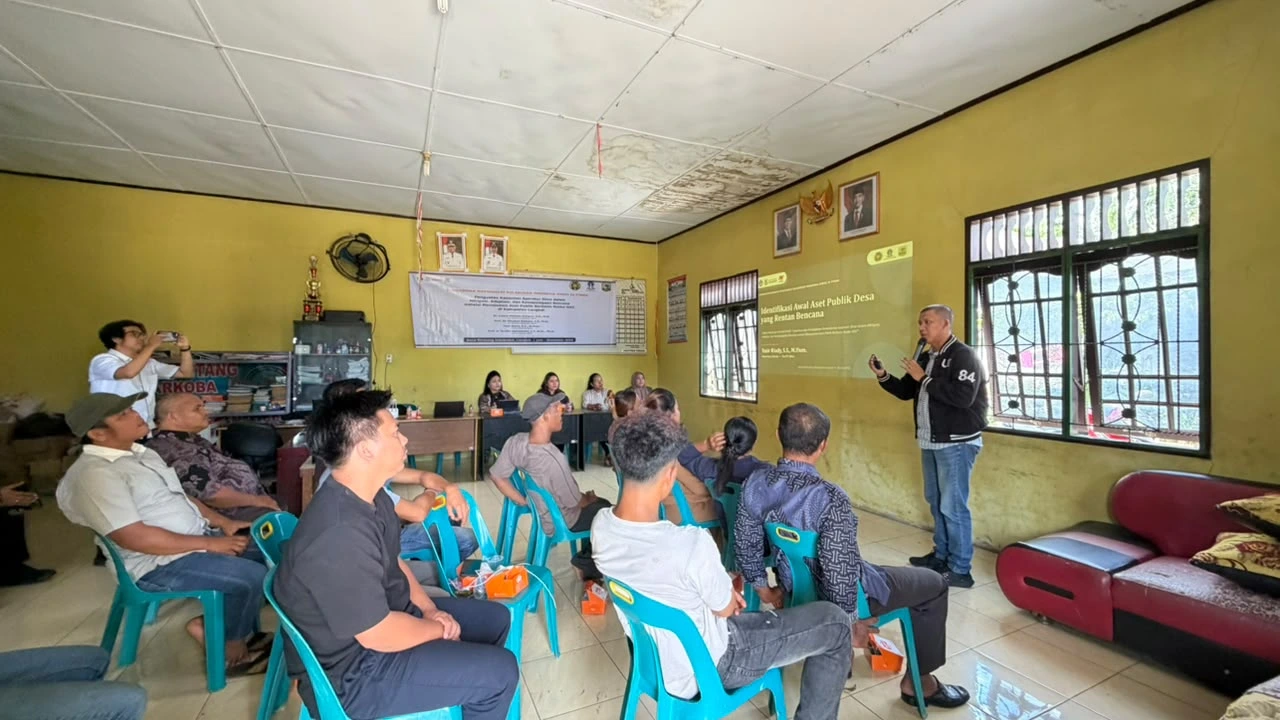
The program was attended by village heads, village officials, members of the Village Consultative Body (BPD), community leaders, and various local stakeholders. Discussions were highly interactive, addressing current challenges faced by Kutabuluh Village, including flood risks, infrastructure damage, disruptions to public services, and the need for more systematic strategies to protect village assets.
As part of the program, participants also conducted the identification and mapping of public assets considered highly vulnerable to disasters. Using a participatory approach, strategic assets—including village roads, bridges, educational facilities, healthcare centers, clean water infrastructure, agricultural areas, and public service buildings—were assessed based on their level of disaster risk. The resulting asset mapping is expected to serve as the foundation for determining mitigation priorities, allocating budgets, and developing more disaster-resilient village development plans.
This asset mapping initiative is expected to strengthen the village's economic resilience, maintain community access to healthcare and education, and safeguard productive assets that support local livelihoods. Consequently, disaster mitigation efforts become not only a means of reducing risks but also an integral component of inclusive and sustainable rural development in line with the SDGs.
In addition to enhancing the capacity of village officials, the program introduced risk-based public asset management as an innovative governance approach capable of supporting sustainable development. This approach encourages village governments to integrate asset data, risk assessments, and mitigation strategies into village development planning documents, ensuring that future development investments are more resilient to disaster threats.
Through the Indonesian Collaborative Community Service Program (PMKI), the synergy among the 24 PTNBH institutions is expected to continue generating innovations, community assistance, and knowledge transfer that create tangible benefits for society. This collaboration serves as a concrete example of SDG 17 (Partnerships for the Goals) in action while simultaneously advancing SDG 1 (No Poverty), SDG 2 (Zero Hunger), SDG 3 (Good Health and Well-being), and SDG 4 (Quality Education) by strengthening the capacity of village governments to manage public assets in an adaptive, sustainable, and community-oriented manner.